
Mobile banking, online shopping, and social networking have all been made feasible because of corporate and enterprise adoption of the Internet. Although it has given us many options, it is not entirely safe since cybercriminals are drawn to its anonymity. So, you can thoroughly understand cybersecurity if you want to safeguard yourself against today’s cyber threats. You can better understand cybersecurity principles by reading this article.
Let’s look at the subjects addressed in this post on cybersecurity fundamentals:
- The history of Cybersecurity
- What is Cybersecurity?
- Why is cybersecurity important?
- The CIA Triad
The history of Cybersecurity
Words like worms, viruses, trojan horses, spyware, and malware weren’t even in the common information technology (IT) lexicon forty years ago. Only because of the emergence of viruses did cybersecurity emerge.
Beginning as a research project, cybersecurity has a long history. The first computer “worm” was developed in the 1970s by Robert Thomas, a researcher for BBN
Technologies in Cambridge, Massachusetts. The Creeper was the name of it. “ I’M THE CREEPER: CATCH ME IF YOU CAN ” was the Creeper message that displayed as it hopped from system to system infecting computers. The email was invented by Ray Tomlinson, who also designed The Reaper, the first antiviral programme that would hunt down and eliminate Creeper.
Robert Morris came up with the notion to measure the size of the internet towards the end of 1988. He created software that entered Unix terminals, traversed networks, and cloned itself to accomplish this. The Morris worm was so aggressive that it rendered computers completely unusable by drastically slowing them down. Afterward, he was the first person to be found guilty under the Computer Fraud and Abuse Act.
From that point, Viruses grew deadlier, more invasive, and more difficult to manage.
The development of cybersecurity coincided with it.
What is cybersecurity?
The field of technologies, procedures, and procedures used to safeguard networks, computers, programs, and data against harm, attack, and illegal access is known as cybersecurity.

Cybersecurity refers to methods and procedures used to safeguard digital data. the information that is used, stored or transferred by an information system. Data, after all, is what the criminal wants. Computers, servers, and networks are merely access points for the data. Effective cybersecurity lowers the risk of cyberattacks and safeguards people and businesses from unlawful use of systems, networks, and technology.
The threats change daily as attackers get more creative; therefore, describing cybersecurity clearly and recognizing cybersecurity fundamentals is crucial.
Why is cybersecurity important?
The following reasons are why cybersecurity is crucial in the predominant digital world:
- The sheer volume of threats is steadily growing with each passing year. According to McAfee research, cybercrime has increased from $250 billion to over $400 billion since two years ago.
- Cyber attacks can cost firms a lot of money to deal with. A data breach can cause the company irreparable reputational harm in addition to financial harm.
- Today’s cyberattacks are getting increasingly destructive. Cyberattacks are being launched by criminals using more advanced methods.
- Organizations are being compelled by regulations like GDPR to properly protect the personal data they own.
The abovementioned factors have made cybersecurity a crucial component of business,
and the current emphasis is on creating adequate reaction plans that limit harm in the event of a cyber attack.
The CIA Triad
The CIA triad, also known as confidentiality, integrity, and availability, is a paradigm used to help businesses and other organizations create their security policies. Strictly speaking, cybersecurity refers to safeguarding data against unauthorized access, alteration, and deletion to maintain confidentiality, integrity, and availability.
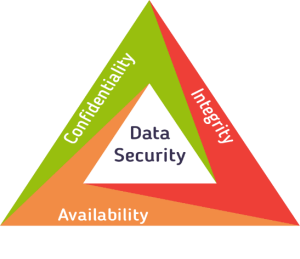
Confidentiality
To maintain confidentiality, parties with permission to share and possess data must keep their identities secret. Often, confidentiality is compromised by decrypting data that was improperly encrypted, Man-in-the-Middle (MITM) attacks, and revealing sensitive information.
Integrity
Integrity relates to preventing unauthorized parties from changing data. It is necessary that information and programmes only be altered in certain and approved ways. Integrity risks include transforming a computer into a “zombie computer” and incorporating viruses into web pages.
Availability
Availability refers to ensuring that the data is accessible to the right people at the right time. Data is only useful if the appropriate individuals can access it at the appropriate moment. Information inaccessibility can be caused by security issues such as DDoS assaults, hardware malfunctions, faulty software, and human mistake.