
POINTERS AND STRINGS
In programming, strings and pointers are two fundamental concepts that play a crucial role in manipulating and managing data. Strings are used to store and manipulate text, while pointers are used to manage memory and data structures. In this blog, we’ll explore these concepts in detail and discuss how they work together in C and C++
Strings
A string is simply an array of characters terminated by a null character (‘\0’). Strings are widely used in programming to store and ma
nipulate text. In C and C++, strings are represented as arrays of characters. For example, to declare a string in C, you can use the following code:
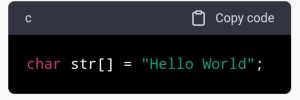
In this code, we declare a character array str with e
nough space to store the string “Hello World” plus one additional character for the null terminator. In C++, you can use the string class to work with strings. For example, to declare a string in C++, you can use the following code.
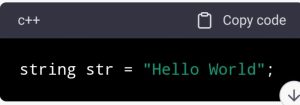
In both C and C++, you can manipulate strings using a wide range of functions and methods. For example, you can use the strlen function in C to get the length of a string:
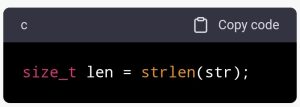
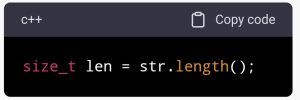
In C++, you can use the length method of the string class to get the length of a string:
Pointers
A pointer is a variable that holds the memory address of another variable. Pointers are widely used in programming to manage memory and data structures. In C and C++, pointers are declared using the * operator. For example, to declare a pointer to an integer in C, you can use the following code:
Introduction
Pointers are a fundamental concept in computer programming that allow for dynamic memory allocation and manipulation. Simply put, a pointer is a variable that holds the memory address of another variable. Pointers are used extensively in low-level programming languages such as C and C++ but are also used in other programming languages like Python and Java.
Benefits:
One of the main benefits of pointers is that they allow for dynamic memory allocation. Dynamic memory allocation is the ability to allocate memory at runtime rather than at compile time. This means that the size of the memory can be determined based on the user’s input or other runtime factors. This feature is essential when working with complex data structures such as linked lists, trees, and graphs.
To understand pointers, it is important to understand how memory is managed in a computer. Memory is typically divided into two parts: the stack and the heap. The stack is a contiguous block of memory used for static memory allocation. When a function is called, the stack is used to store local variables, function parameters, and other data. The heap, on the other hand, is used for dynamic memory allocation. When memory is allocated on the heap, a pointer to the memory address is returned.
A pointer variable in C or C++ is declared using the “*” operator. For example, the following code declares a pointer variable that points to an integer:
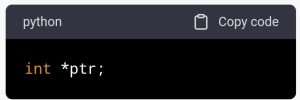
This code declares a pointer variable named “ptr” that can hold the memory address of an integer. To assign the address of an integer variable to the pointer variable, the “&” operator is used. For example: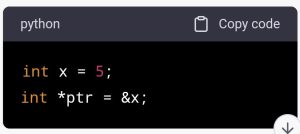
This code declares an integer variable “x” and initializes it to 5. Then, it declares a pointer variable “ptr” and assigns the memory address of “x” to it. Now, the pointer variable “ptr” points to the integer variable “x”.
To access the value stored in the memory location pointed to by a pointer, the “*” operator is used again. For example:
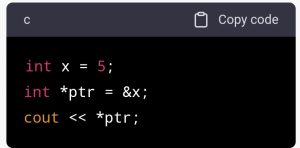
This code declares an integer variable “x” and initializes it to 5. Then, it declares a pointer variable “ptr” and assigns the memory address of “x” to it. Finally, it prints the value stored in the memory location pointed to by ”
Conclusion:
In C and C++, strings are usually represented using character arrays, and pointers are commonly used to manipulate strings. Pointers are essential for many programming tasks, including dynamic memory allocation, data structures, and function pointers. Understanding the relationship between strings and pointers is crucial for writing efficient and reliable code in C and C++
Reference:
Pointers in C – GeeksforGeeks. (n.d.). GeeksforGeeks. Retrieved February 28, 2023, from https://www.geeksforgeeks.org/pointers-in-c/
Strings in C – GeeksforGeeks. (n.d.). GeeksforGeeks. Retrieved February 28, 2023, from https://www.geeksforgeeks.org/strings-in-c-2/
B.Pavan Kalyan
22VV1A1201
Information Technology